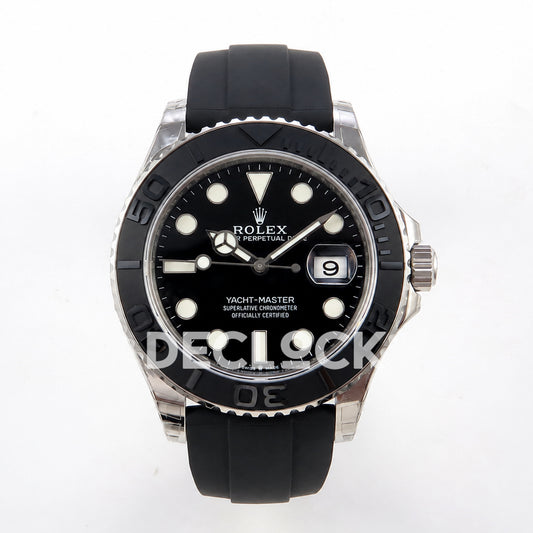
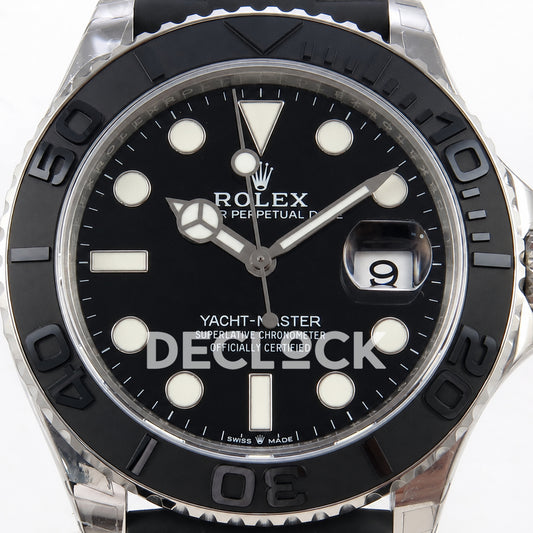
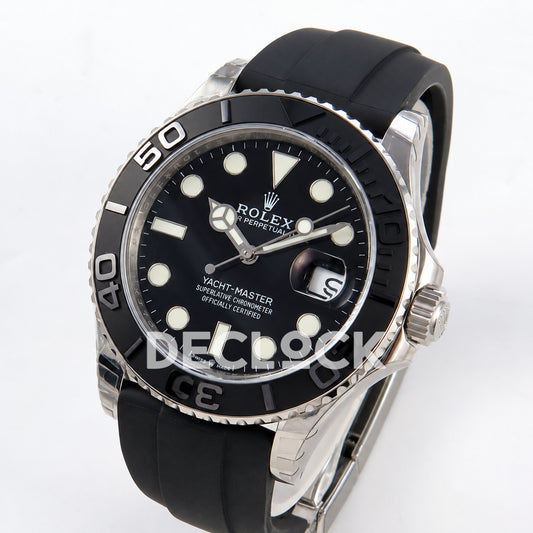
The terms Free Sprung and regulated are appearing more and more frequently in descriptions of modern mechanical and replica watches. Their essential difference is not merely aesthetic: it concerns the way in which the watchmaker regulates the oscillation speed of the balance wheel and, consequently, the watch's accuracy.
Below, we explain in simple terms how each system works, its practical advantages and disadvantages, and which option best suits your requirements.

The quick answer
- Regulated: easier and more economical adjustment, wide availability of spare parts, and simpler servicing.
- Free Sprung: higher mechanical fidelity, better theoretical stability, and greater resistance of the adjustment to shocks.
- The best choice: depends on manufacturing quality, the QC of the specific watch, and access to a specialized technician.
What is a regulated movement?
In a regulated movement, the active length of the hairspring is changed via a regulator arm. Two small pins hold the spring, and moving the arm makes the active part of the hairspring slightly longer or shorter. This allows the movement to run slower or faster.
This setup has been used for decades in reliable movements such as the ETA 2824/2836, their corresponding clones, and many Miyota architectures. Its great advantage is its practicality: an experienced technician with a timegrapher can make basic adjustments quickly and without rare tools.
What is a Free Sprung movement?
In a Free Sprung movement, the hairspring maintains a constant active length and there is no conventional regulator arm. Adjustment is made by changing the inertia of the balance wheel via very small weights or screws on its periphery, such as Microstella-style weights.
When the weights are moved towards the center, the balance wheel can move faster. When moved towards the periphery, the oscillation slows down. This is a more complex process, requiring precision, appropriate tools, and a technician familiar with this specific architecture.
Accuracy and stability in daily use
A well-designed and adjusted Free Sprung system can allow the hairspring to "breathe" more uniformly, because it is not restricted by curb pins. This creates the conditions for better isochronism, meaning more stable behavior as the mainspring's energy decreases, as well as smaller deviations between different positions of the watch.
However, this does not mean that every Free Sprung replica is automatically more accurate than every regulated version. The final performance depends on manufacturing tolerances, assembly, lubrication, QC, and the correct adjustment of the specific movement. A quality regulated movement can perform better than a poorly adjusted Free Sprung one.
Durability, service, and repair
The absence of a movable regulator arm gives the Free Sprung a practical advantage against strong shocks: there is no arm that can shift and suddenly alter the adjustment. This does not make the watch invulnerable, but it helps the adjustment remain stable.
On the other hand, the regulated movement is usually easier to own. More watchmakers are familiar with its adjustment, the tools are common, and the process is more economical. In a Free Sprung clone, a worn or overly tightened micro-weight can make adjustment challenging and more expensive.
Free Sprung vs Regulated: comparison table
| Criterion | Regulated | Free Sprung |
|---|---|---|
| Adjustment method | Change in active hairspring length via regulator arm | Change in balance wheel inertia via micro-weights |
| Accuracy potential | Very good when properly adjusted | High theoretical stability in quality implementation |
| Stability at power reserve | May show greater variations | Potentially better isochronism |
| Deviation per position | Strongly depends on adjustment and quality | Potentially smaller with correct implementation |
| Resistance of adjustment to shocks | Regulator arm may shift | No conventional regulator arm |
| Ease of adjustment | Easy and fast for most technicians | Requires special tools and experience |
| Service and spare parts | Usually easier and more economical | More limited technical support |
| Mechanical fidelity | Practical solution, not always identical to gen architecture | Closer to high-end authentic constructions when true clone |
| Ideal for | Easy ownership, service, and value for money | Collectors who want maximum mechanical fidelity |
What does the difference mean for replica watches?
In modern replica watches, the "Free Sprung" designation only has value when it describes a true functional architecture and not a decorative balance wheel. For this, it is necessary to check the specific factory, caliber, and batch. Two watches with similar appearances can have substantial differences in construction and future serviceability.
For watches with an exhibition caseback, visual and mechanical fidelity gains greater importance. With a closed caseback, a proven reliable regulated movement may be the more logical choice for someone who prioritizes easy maintenance.
Which movement should you choose?
Choose regulated when:
- You want simple, quick, and economical adjustment.
- You are interested in easy technician and spare parts availability.
- You prefer a tried-and-tested solution for daily use.
- You are not concerned with the absolute visual fidelity of the balance system.
Choose Free Sprung when:
- You are looking for the closest possible mechanical architecture to the authentic model.
- You want high stability and strong resistance of the adjustment to shocks.
- The watch has an open caseback and the movement's detail interests you.
- You have access to a technician experienced with Free Sprung clone movements.
Declock's verdict
Free Sprung is the more advanced and faithful choice when implementation and QC are truly good. Regulated remains the most practical solution for easy maintenance and controlled cost. Don't choose based only on the name: evaluate the factory, caliber, real photos, and operational check of the specific watch.
Frequently Asked Questions
Is every Free Sprung movement more accurate?
No. The system offers high stability potential, but actual accuracy depends on manufacturing quality, lubrication, adjustment, and QC.
Does it require different servicing?
Basic maintenance remains similar, but timing adjustment requires special tools and knowledge of the balance wheel's micro-weights.
Can any watchmaker adjust Free Sprung?
Not necessarily. It's important to confirm that the technician has the appropriate tools and experience with this specific family of clone movements.